Hi friends! 👋
Here’s a little secret: the best everyday essentials for busy adults aren’t things you buy. Instead, they’re simple habits and setups that make healthy choices the easy choice, even on your most chaotic days.
In other words, you don’t need a fancy gadget to feel fit-ish. So, let me share the six essentials in my toolkit, and the best part is that they cost zero dollars.
- A simple “if-then” plan
- A ready-to-go setup
- Water within reach
- Kitchen shortcuts
- A wind-down cue
- A kind inner voice
Why do “essentials” matter after 30, 40 and 50?
Let’s be honest. Life is full, energy is limited, and motivation shows up on its own schedule. Meanwhile, a house with three teenagers means chargers, water bottles, and patience disappear daily. 😅
That’s why the easiest wins come from setting things up in advance. As a result, you don’t have to rely on willpower at 6 a.m. or 9 p.m., when it’s usually running low.
Essential 1: A simple “if-then” plan
This one is a game-changer. An “if-then” plan links a clear moment in your day to a small action. For example, “If I pour my morning coffee, then I’ll stretch for two minutes.”
Does it really work? A 2006 review by researchers Peter Gollwitzer and Paschal Sheeran looked at 94 studies and found that these plans had a medium-to-large average effect on goal attainment. In addition, a larger 2024 review of 642 tests found that effects were bigger when plans used an if-then format and were rehearsed.
However, here’s a quick reality check: planning helps most when you truly want the goal. One review found that groups with little intention to exercise saw an effect near zero. So, pick a goal that matters to you, not one someone else says you should have.
Essential 2: A ready-to-go setup
Think of this as a gift to “future you.” First, take five minutes at night to set up tomorrow, such as:
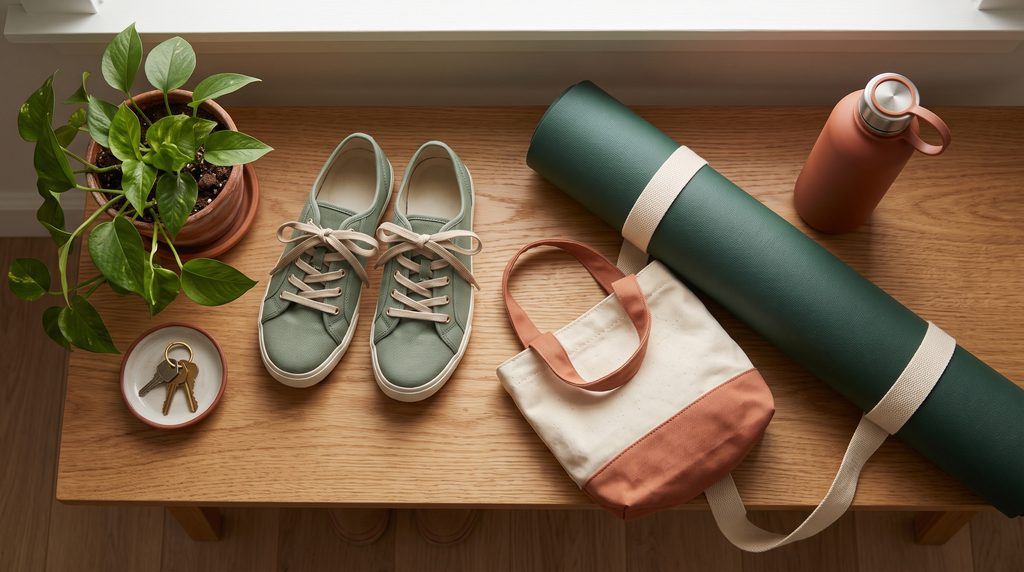
- Laying out your workout clothes or putting your shoes by the door
- Packing your gym bag, or setting up your mat in a visible spot
- Placing your water bottle where you’ll see it first thing
Here’s why it works: when the healthy choice is right in front of you, it takes less effort. Therefore, you’ll do it more often, even when you’re tired.
Essential 3: Water within reach
It sounds almost too simple, but hydration is easy to forget when you’re juggling everything. In fact, Canada’s Food Guide suggests making water the drink of choice.
So, keep a bottle or glass wherever you spend most of your day, like on your desk, in the car, or on the kitchen counter. Plus, if you can see it, you’re more likely to sip it. 💧
Essential 4: Kitchen shortcuts
I talked about this in my post on quick family dinners, and it’s worth repeating. Shortcuts are not cheating. In fact, Canada’s Food Guide notes that fresh, frozen, and canned vegetables and fruits are all good choices.
- Keep frozen veggies in the freezer for any emergency
- Stock canned beans or chickpeas for instant protein
- Cook a double batch of rice or beans and eat twice
- Choose one “default” dinner for the nights when you have zero energy
Essential 5: A wind-down cue
Sleep is the secret weapon of a fit-ish life. According to the CDC, a consistent bedtime and a quiet, dark, comfortable bedroom can improve sleep.
Meanwhile, a “cue” tells your brain that the day is over. For example, try dimming the lights, putting your phone on the charger across the room, or doing a quick stretch. For more ideas, check out my guide on sleep after 30, 40 and 50. 😴
Essential 6: A kind inner voice
This is my favorite essential, and it’s free. Habits take time, and that’s completely normal.
Researchers at University College London found that it takes an average of 66 days for a new habit to become automatic. Even better, they reported that missing one opportunity didn’t materially affect the habit-formation process.
So, if you skip a day, you haven’t failed. Instead, you’re just human, and you can simply pick it up again tomorrow. 💚
Also, the same study notes that individual times varied widely, from 18 days up to 254 days. Therefore, be patient with yourself.
How can I build my toolkit in 15 minutes?
Don’t try to do everything at once. Instead, follow this simple plan:
- Pick one essential from the list above that feels easiest
- Then write one if-then sentence (for example, “If I brush my teeth at night, then I’ll set out my shoes”)
- Next, set up your space by placing your water, shoes, or bag where you’ll see them
- After that, do it for one week and notice how it feels
- Finally, add a second essential only when the first feels easy
Small steps count. In fact, they always do. 🌱
What about everyday gear?
You might be wondering about the actual stuff, like shoes, bottles, and kitchen helpers. Good question! I’ll share my honest favorites in future posts, and I’ll always explain why they save time or make life easier. For now, I wanted to show you that the foundation is habits first, stuff second.
FAQ: Everyday essentials for busy adults
What are the best everyday essentials for busy adults?
The most useful ones are simple systems: an if-then plan, a ready-to-go setup, water within reach, kitchen shortcuts, a wind-down cue, and a kind inner voice. Best of all, they cost nothing, and they work for almost any lifestyle.
How long does it take to build a new habit?
It varies. One well-known UCL study found an average of 66 days, with individual times ranging from 18 to 254 days. However, missing a single day didn’t derail the process, so be patient and keep going.
Do I need to buy special gear to be fit-ish?
Not at all. Instead, start with what you have. Later, if a tool makes your routine easier or more enjoyable, it can be a nice bonus, but it’s never required.
Final thoughts: start with habits, not stuff
Everyday essentials for busy adults aren’t about having the perfect setup. Instead, they’re about making your life a little easier, one small step at a time. So, pick one essential today. Maybe it’s filling your water bottle, or maybe it’s setting your shoes by the door. Either way, that’s already a win. 🎉
Now I’d love to hear from you: what’s one small thing that makes your day easier? Tell me in the comments! 👇
Disclaimer: I’m not a doctor, and this post is for general information only, not medical advice. Please talk to a healthcare professional before making changes to your health routine.
Sources & Further Reading
- Habit formation (66 days on average): How long does it take to form a habit? (UCL News)
- Range of 18 to 254 days: How Long It Really Takes to Build a New Habit (James Clear)
- If-then plans (2006 meta-analysis): Gollwitzer & Oettingen, Planning Goal Striving (University of Konstanz)
- If-then plans (2024 meta-analysis of 642 tests): The when and how of planning (University of Konstanz)
- Planning works best with strong intentions: A meta-analysis of 642 tests (Silicon Canals)
- Water as the drink of choice: Canada’s Food Guide: nutrition information (Ontario.ca)
- Fresh, frozen and canned vegetables: Canada’s Food Guide plate tips (FreshCo)
- Healthy plate basics: Use Canada’s Food Guide plate to make any meal (Health Canada)
- Sleep habits: Tips for Better Sleep (CDC)